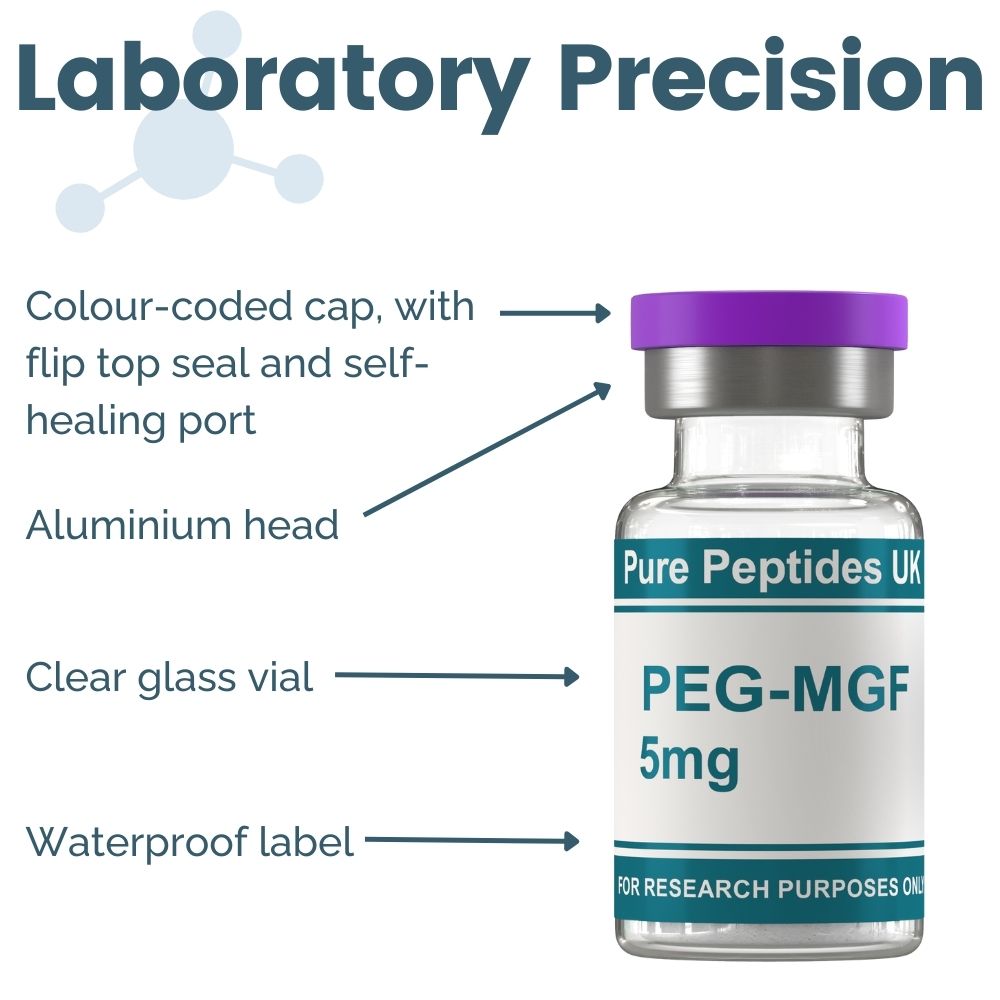

PEG-MGF 5mg
(Note: This product is a larger size than the standard 2mg typically sold.)
Overview
Pegylated Mechano-Growth Factor (PEG-MGF) is a modified form of insulin-like growth factor-1 (IGF-1), specifically derived from the IGF-1 Ec splice variant. Through pegylation – the attachment of polyethylene glycol (PEG) – the stability and circulation time of the native peptide are greatly enhanced.
This modification reduces renal clearance and shields the peptide from enzymatic breakdown, resulting in a longer biological half-life and improved experimental reliability. PEG-MGF is widely used in growth-factor, muscle-adaptation, and cell-recovery research, helping scientists investigate how cells respond to physical or mechanical stress.
Scientific Background
Mechano-Growth Factor (MGF) is a naturally occurring isoform of IGF-1, expressed in response to mechanical loading or tissue damage. It has been studied for its role in initiating muscle-cell repair and regeneration.
Because unmodified MGF degrades rapidly in the body, researchers developed PEG-MGF to improve its half-life and maintain activity over extended observation periods. This allows for more consistent data and the possibility to study prolonged growth-factor signalling effects.
Mechanism of Action
PEG-MGF interacts with the IGF-1 receptor pathway, triggering several key intracellular responses:
-
Satellite-cell activation and myogenic differentiation
-
Protein-synthesis stimulation through the PI3K/Akt/mTOR cascade
-
Cellular repair and recovery following physical or metabolic stress
-
Tissue adaptation linked to mechanical overload
The pegylated modification enables PEG-MGF to remain active for longer than native MGF, offering researchers valuable opportunities to examine long-term anabolic signalling.
Research Focus Areas
-
Muscle Repair and Regeneration – Investigating PEG-MGF’s ability to stimulate satellite-cell proliferation and muscle-fibre recovery.
-
Growth-Factor Signalling – Studying sustained activation of the IGF-1 receptor and downstream anabolic pathways.
-
Cellular Recovery Mechanisms – Exploring the peptide’s contribution to tissue healing and adaptation after mechanical or oxidative stress.
-
Extended-Stability Comparisons – Comparing pegylated and non-pegylated peptides to understand differences in bioavailability and duration of activity.
Technical Details
- Synonyms: Pegylated MGF, PEG IGF-1 Ec, PEG Myotrophin
- Sequence: PEG-Suc-YQPPSTNKNTKSQ(d-R)(d-R)KGSTFEEHK-NH₂
- IUPAC Condensed: PEG-Suc-Tyr-Gln-Pro-Pro-Ser-Thr-Asn-Lys-Asn-Thr-Lys-Ser-Gln-Arg-Arg-Lys-Gly-Ser-Thr-Phe-Glu-Glu-His-Lys-NH₂
- Molecular Weight: Variable due to PEG modification
- CAS Number: Not individually assigned (variant of IGF-1 Ec)
- PubChem CID: 178101669
Stability and Storage
Store lyophilised protein at –20 °C.
After reconstitution, aliquot to prevent repeated freeze–thaw cycles.
Reconstituted solution may be stored at 4 °C for short-term use.
The lyophilised peptide remains stable until its expiry date when kept at –20 °C.
Source and Reconstitution
Source: Biosynthesis
Reconstitution: Reconstitute with Bacteriostatic Water
Usage
Product is prepared for laboratory research only.
PEG-MGF for sale at Pure Peptides UK is limited to scientific and educational use.
Only purchase PEG-MGF if you are a licenced researcher.
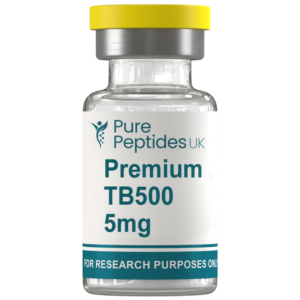
Images for illustration purposes only.
Conclusion
PEG-MGF 5 mg offers a larger research quantity of this advanced pegylated IGF-1 variant, enabling extended experimentation and comparative studies. Its enhanced stability, prolonged half-life, and involvement in muscle-regeneration pathways make it an invaluable tool for researchers exploring growth-factor biology and cellular recovery processes.
For smaller-scale studies, the standard 2 mg format is also available.