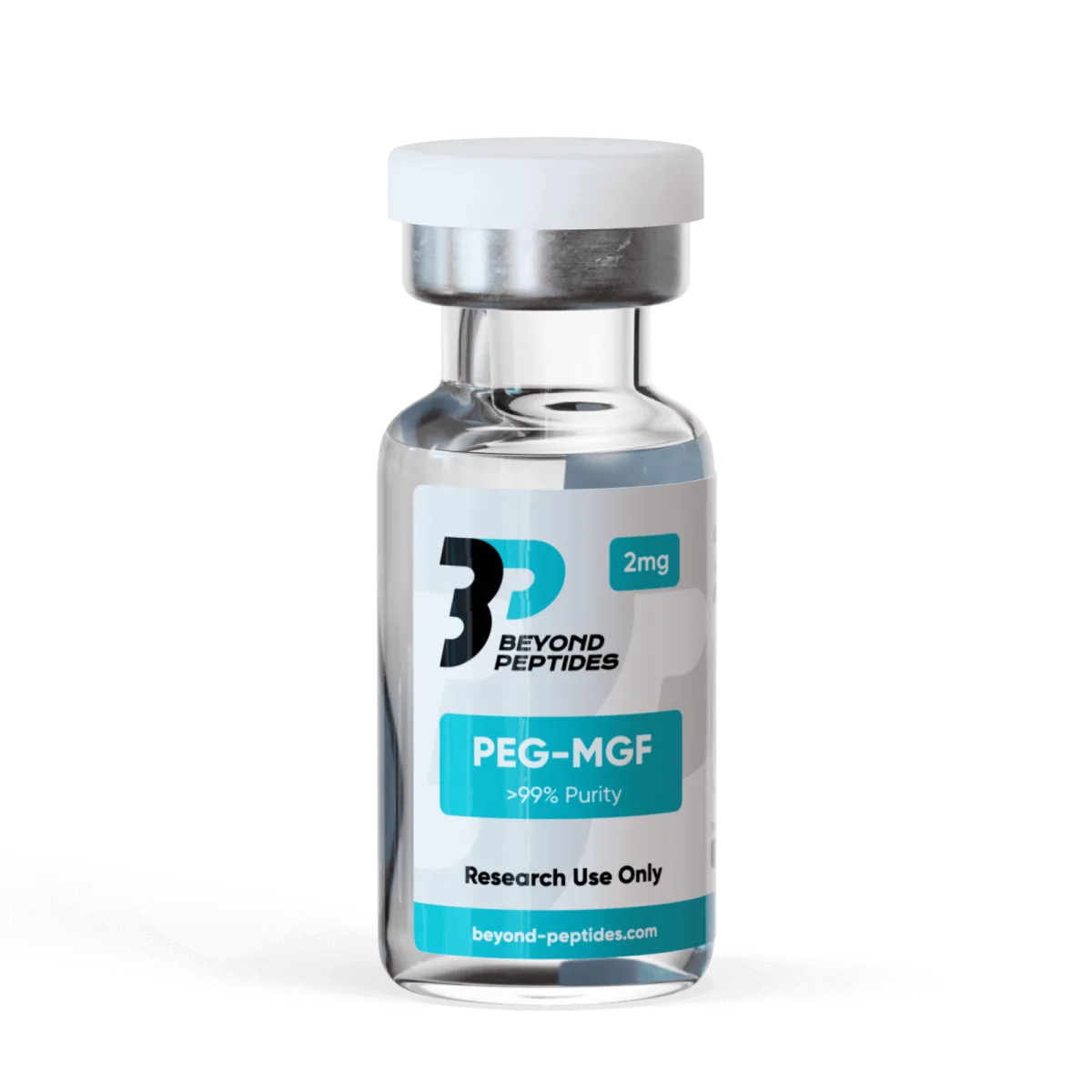


Premium PEG-MGF (Pegylated Mechano Growth Factor) for Sale | 2mg Lyophilized Powder | ≥98% Purity | 48-Hour Delivery Across EU & UK
PEG-MGF: The Advanced Pegylated Mechano Growth Factor for Muscle Regeneration Research
Buy PEG-MGF Peptide EU & UK, eupeptidelap.co.uk is proud to present PEG-MGF Peptide (Pegylated Mechano Growth Factor), a premium research-grade pegylated form of Mechano Growth Factor manufactured to the highest analytical standards. As a trusted peptide vendor uk and leading EU peptide supplier, we provide researchers across Europe with PEG-MGF for sale that delivers exceptional purity, consistency, and documented quality for advanced studies in skeletal muscle regeneration, satellite cell activation, and tissue repair mechanisms. Buy PEG-MGF Peptide EU & UK
Mechano Growth Factor (MGF) is a splice variant of insulin-like growth factor-1 (IGF-1) that is expressed in response to mechanical stimulation, particularly in skeletal muscle following resistance exercise or tissue damage . Unlike systemic IGF-1, MGF is produced locally within muscle tissue and acts as a key regulator of satellite cell activation, proliferation, and muscle repair . The peptide plays a critical role in the early stages of muscle regeneration, promoting the expansion of satellite cells that are essential for muscle growth and repair. Buy PEG-MGF Peptide EU & UK
PEG-MGF is a modified version of the MGF peptide that has been conjugated with polyethylene glycol (PEG) to enhance its stability, extend its half-life, and improve its bioavailability in research settings . The PEGylation process involves attaching polyethylene glycol chains to the peptide, which reduces proteolytic degradation and slows renal clearance, allowing for more sustained biological activity . This modification makes PEG-MGF particularly valuable for research applications requiring prolonged exposure to the peptide .
For researchers seeking to buy peptide online EU for investigations into muscle regeneration, satellite cell biology, or tissue repair mechanisms, eupeptidelap.co.uk offers this premium research compound with comprehensive documentation, including Certificates of Analysis and batch-specific purity data. Whether your laboratory is based in London, Berlin, Paris, or anywhere in the European Union, our guaranteed 48 hour delivery peptide service ensures your research continues without interruption.
The Scientific Foundation of PEG-MGF Research
Understanding Mechano Growth Factor (MGF)
Mechano Growth Factor (MGF) is a splice variant of the insulin-like growth factor-1 (IGF-1) gene that is produced in response to mechanical stress and tissue damage . Unlike the systemic form of IGF-1, which is produced primarily in the liver, MGF is expressed locally in skeletal muscle following exercise or injury . The peptide has a unique structure that distinguishes it from other IGF-1 isoforms, containing a specific C-terminal sequence that is critical for its biological activity .
MGF plays a fundamental role in the early stages of muscle regeneration by:
-
Activating Satellite Cells: MGF stimulates the proliferation of satellite cells, the resident muscle stem cells responsible for muscle repair and growth
-
Promoting Myoblast Proliferation: The peptide induces the proliferation of myoblasts, allowing for the expansion of muscle precursor cells
-
Inhibiting Differentiation: During the early regenerative phase, MGF delays differentiation to allow for sufficient cell number expansion before fusion into myotubes
-
Supporting Neuroprotection: MGF has also been shown to have neuroprotective effects, promoting survival of motor neurons following injury
The PEGylation Advantage
PEGylation refers to the covalent attachment of polyethylene glycol (PEG) chains to a peptide or protein . This modification offers several advantages for research applications:
-
Extended Half-Life: PEGylation reduces renal clearance and proteolytic degradation, significantly extending the peptide’s half-life in circulation
-
Enhanced Stability: The PEG chains protect the peptide from enzymatic degradation, improving stability in biological fluids
-
Improved Bioavailability: PEGylated peptides often demonstrate better tissue distribution and cellular uptake
-
Reduced Immunogenicity: PEGylation can reduce the immunogenic potential of the peptide
For MGF, PEGylation is particularly valuable because the native peptide has a short half-life, limiting its utility in research requiring sustained exposure . PEG-MGF provides a more stable and longer-acting form of the peptide, enabling researchers to study its effects over extended time courses .
Mechanism of Action: Satellite Cell Activation and Muscle Regeneration
PEG-MGF exerts its effects primarily through activation of satellite cells, the muscle stem cells responsible for postnatal muscle growth, repair, and regeneration . The mechanism involves:
IGF-1 Receptor Binding: MGF binds to the IGF-1 receptor (IGF-1R) on satellite cells and myoblasts, activating downstream signalling cascades .
PI3K/Akt Pathway: Activation of IGF-1R stimulates the PI3K/Akt pathway, promoting cell survival, proliferation, and protein synthesis .
MAPK/ERK Pathway: The peptide also activates the MAPK/ERK pathway, which is involved in cell proliferation and differentiation .
Myogenic Regulatory Factors: MGF induces the expression of myogenic regulatory factors (MRFs) such as MyoD, Myf5, and myogenin, which control the progression of muscle differentiation .
Cell Cycle Progression: MGF promotes cell cycle progression in satellite cells, allowing for expansion of the myogenic precursor pool before differentiation and fusion into new muscle fibres .
Key Research Applications
Skeletal Muscle Regeneration Research
PEG-MGF is extensively used in studies investigating the mechanisms of muscle repair and regeneration:
-
Muscle Injury Models: Investigate the role of MGF in promoting recovery following muscle trauma, strain, or contusion
-
Satellite Cell Activation: Study the molecular mechanisms regulating satellite cell proliferation and differentiation
-
Muscle Wasting Conditions: Explore the potential of MGF to counteract muscle loss in cachexia, sarcopenia, and other wasting disorders
-
Exercise Physiology: Investigate the role of MGF in the adaptive response to resistance exercise and mechanical loading
Stem Cell and Progenitor Cell Research
PEG-MGF is a valuable tool for studying muscle stem cell biology:
-
Satellite Cell Proliferation: Study the factors controlling satellite cell expansion and self-renewal
-
Myogenic Differentiation: Investigate the transition from proliferation to differentiation in myogenic cells
-
Stem Cell Niche: Explore the interactions between satellite cells and their microenvironment
-
Adult Stem Cell Biology: Investigate the broader role of MGF in adult stem cell populations
Neuroprotection and Neuromuscular Research
MGF has demonstrated neuroprotective properties that are relevant for neuromuscular research:
-
Motor Neuron Survival: Study the effects of MGF on motor neuron survival following injury or in models of motor neuron disease
-
Neuromuscular Junction: Investigate the role of MGF in maintaining neuromuscular junction integrity
-
Peripheral Nerve Injury: Explore the potential of MGF to promote nerve regeneration following injury
Cardiovascular Research
MGF is expressed in cardiac muscle and may have applications in cardiovascular research:
-
Cardiac Regeneration: Study the role of MGF in cardiac muscle repair following myocardial injury
-
Cardiomyocyte Survival: Investigate the protective effects of MGF on cardiomyocytes under stress conditions
Wound Healing and Tissue Repair
Beyond muscle, MGF may have broader applications in tissue repair research:
-
Soft Tissue Healing: Explore the effects of MGF on healing of tendons, ligaments, and other connective tissues
-
Dermal Wound Healing: Investigate the potential of MGF to promote skin wound closure and regeneration
Quality Assurance: Setting the Standard for Research Compounds
Manufacturing Excellence
eupeptidelap.co.uk sources PEG-MGF Peptide from certified GMP facilities with rigorous quality control protocols:
-
HPLC Purity Analysis: ≥98% purity verified by high-performance liquid chromatography
-
Mass Spectrometry Verification: Molecular weight confirmation via LC-HRMS
-
PEGylation Confirmation: Verified PEG chain attachment and molecular weight
-
Batch-Specific Certificates of Analysis: Complete documentation for each production run
-
Research-Use Only (RUO) Labeling: Full compliance with research compound regulations
Chemical and Product Specifications
| Specification | Detail |
|---|---|
| Product Name | PEG-MGF Peptide (Pegylated Mechano Growth Factor) |
| CAS Number | Not assigned for PEGylated form |
| Molecular Weight | ~20-25 kDa (PEGylated) |
| Base Peptide | MGF (Mechano Growth Factor) |
| PEGylation | Covalent PEG attachment for extended half-life |
| Purity | ≥98% (HPLC verified) |
| Appearance | White to off-white lyophilized powder |
| Form | Lyophilized powder |
| Solubility | Soluble in sterile water, bacteriostatic water, or PBS |
| Target Receptor | IGF-1 receptor (IGF-1R) |
| Key Pathways | PI3K/Akt, MAPK/ERK, myogenic regulatory factors |
| Storage (Lyophilized) | -20°C; protect from light and moisture |
| Storage (Reconstituted) | 2-8°C for short-term; aliquot and store at -20°C for longer storage |
| Shelf Life | 24 months from date of manufacture (lyophilized) |
| Intended Use | Research and laboratory use only |
| Documentation | Certificate of Analysis provided with each batch |
Stability and Handling Guidelines
Lyophilized Powder Storage: Store lyophilized PEG-MGF powder at -20°C in a dry, dark environment, protected from light and moisture . Under proper storage conditions, the powder maintains stability for up to 24 months from the date of manufacture. The PEGylation enhances stability compared to native MGF .
Reconstitution Protocol:
-
Allow vial and solvent to reach ambient temperature before opening to prevent condensation
-
Reconstitute using sterile bacteriostatic water or appropriate buffer according to research protocol
-
Inject solvent slowly down the inside wall of the vial to minimize foaming
-
Gently swirl or roll the vial until fully dissolved—do not shake vigorously
-
Label the vial with the date of reconstitution
-
Refrigerate immediately at 2-8°C
Reconstituted Solution Storage: Store reconstituted PEG-MGF at 2-8°C for short-term use. For longer-term storage, aliquot into single-use portions and store at -20°C . Avoid repeated freeze-thaw cycles.
Protection from Light and Moisture:
-
Store in original packaging protected from light
-
Keep vials tightly sealed when not in use
-
Allow refrigerated vials to reach room temperature before opening to prevent condensation
Key Benefits
-
Premium Quality Manufacturing: GMP-certified production, ≥98% HPLC-verified purity with lot-specific COAs
-
PEGylated Formulation: Extended half-life and enhanced stability for sustained research applications
-
Satellite Cell Activation: Promotes proliferation of muscle stem cells for regeneration research
-
Muscle Regeneration Studies: Investigate mechanisms of muscle repair following injury or in wasting conditions
-
Exercise Physiology Research: Study MGF expression and function in response to mechanical loading
-
Sarcopenia and Cachexia: Explore potential countermeasures for age-related and disease-related muscle loss
-
Stem Cell Biology: Investigate satellite cell proliferation, self-renewal, and differentiation
-
Neuroprotection Research: Study effects on motor neuron survival and neuromuscular junction integrity
-
Cardiovascular Applications: Explore roles in cardiac muscle repair and cardiomyocyte protection
-
Wound Healing Studies: Investigate broader tissue repair applications
-
Localized Expression: Mimics the natural production of MGF in response to mechanical stimulation
-
Well-Characterized: Extensive research on MGF biology and function
-
Comprehensive Documentation: Certificates of Analysis with batch-specific purity data
-
48-Hour EU & UK Delivery: Rapid shipping to research facilities across Europe
-
Batch Consistency: Rigorous quality control ensures lot-to-lot reproducibility
-
EU Sourced: Available from within the European Union
Frequently Asked Questions
Q: What is PEG-MGF and how does it work?
A: PEG-MGF (Pegylated Mechano Growth Factor) is a modified form of Mechano Growth Factor, a splice variant of IGF-1 expressed in response to mechanical stimulation . It activates satellite cells (muscle stem cells) through the IGF-1 receptor, promoting cell proliferation and expansion before differentiation into new muscle fibres . PEGylation extends its half-life and enhances stability .
Q: What purity level can I expect when I buy PEG-MGF from eupeptidelap.co.uk?
A: All PEG-MGF Peptide from eupeptidelap.co.uk is tested to ≥98% purity by HPLC, with Certificates of Analysis provided with every order . Each batch is individually analyzed, ensuring you receive material suitable for rigorous research applications.
Q: How is PEG-MGF different from native MGF?
A: PEG-MGF is covalently attached to polyethylene glycol (PEG) chains, which significantly extends the peptide’s half-life by reducing renal clearance and proteolytic degradation . This modification makes PEG-MGF more suitable for research applications requiring sustained exposure .
Q: What is the molecular weight of PEG-MGF?
A: PEG-MGF has a molecular weight of approximately 20-25 kDa due to the PEGylation, compared to native MGF which is approximately 7-10 kDa . The exact molecular weight depends on the specific PEG chain length used .
Q: How should I store PEG-MGF for long-term stability?
A: Store lyophilized PEG-MGF powder at -20°C, protected from light and moisture . Under proper storage conditions, the powder maintains stability for up to 24 months. For short-term use, store reconstituted solution at 2-8°C; for longer-term storage, aliquot and store at -20°C .
Q: What research areas commonly use PEG-MGF?
A: PEG-MGF is widely used in skeletal muscle regeneration research, satellite cell biology, stem cell research, neuroprotection studies, cardiovascular research, and wound healing studies .
Q: What is the role of MGF in muscle regeneration?
A: MGF is expressed locally in muscle tissue following mechanical stimulation or injury . It activates satellite cells, promoting their proliferation and expansion, which is essential for muscle repair and growth . MGF delays differentiation to allow sufficient cell number expansion before fusion into new myofibres .
Q: Do you ship PEG-MGF to EU countries?
A: Yes. As a dedicated EU peptide supplier, we ship PEG-MGF Peptide to all European Union member states with our guaranteed 48 hour delivery peptide service. Our EU fulfilment centre ensures rapid delivery without customs delays. All shipments use protective packaging to maintain compound integrity during transit.
Q: What documentation do you provide with PEG-MGF orders?
A: Every order includes a Certificate of Analysis (COA) with batch-specific purity data . Additional documentation, including HPLC chromatograms and mass spectrometry data, is available upon request for researchers requiring comprehensive analytical verification.
Q: Do you offer bulk quantities of PEG-MGF for institutional research?
A: Yes. We accommodate bulk orders for research institutions. Contact our team at sales@eupeptidelap.co.uk for volume pricing, custom requirements, and supply agreements for ongoing research programs.
Advance Your Research with PEG-MGF Peptide
eupeptidelap.co.uk is your trusted source for PEG-MGF Peptide, the premium choice for researchers investigating skeletal muscle regeneration, satellite cell biology, and tissue repair mechanisms. With its PEGylated formulation providing extended half-life and enhanced stability, PEG-MGF represents a sophisticated tool for exploring the complex biology of muscle stem cell activation and differentiation. ...........................................
Whether you are exploring muscle regeneration pathways, designing satellite cell studies, investigating neuroprotective mechanisms, or researching muscle wasting conditions, our rigorously tested compound provides the quality and consistency your work demands. . . . . . . . . . . . . . . . . . . . . . . . . . . . . . . . . . . . . . . .
Order today and experience the eupeptidelap.co.uk difference – premium quality, rapid 48-hour delivery across the EU and UK, and expert support for the European research community.